Component distributor · 11 markets · technical B2B sales
Illustrative customer journey · Electronics distribution
From fast quotations to traceable technical commitments.
VectorWave Electronics shows how SaleQMS changes with the customer promise, transaction model and risk of the industry.
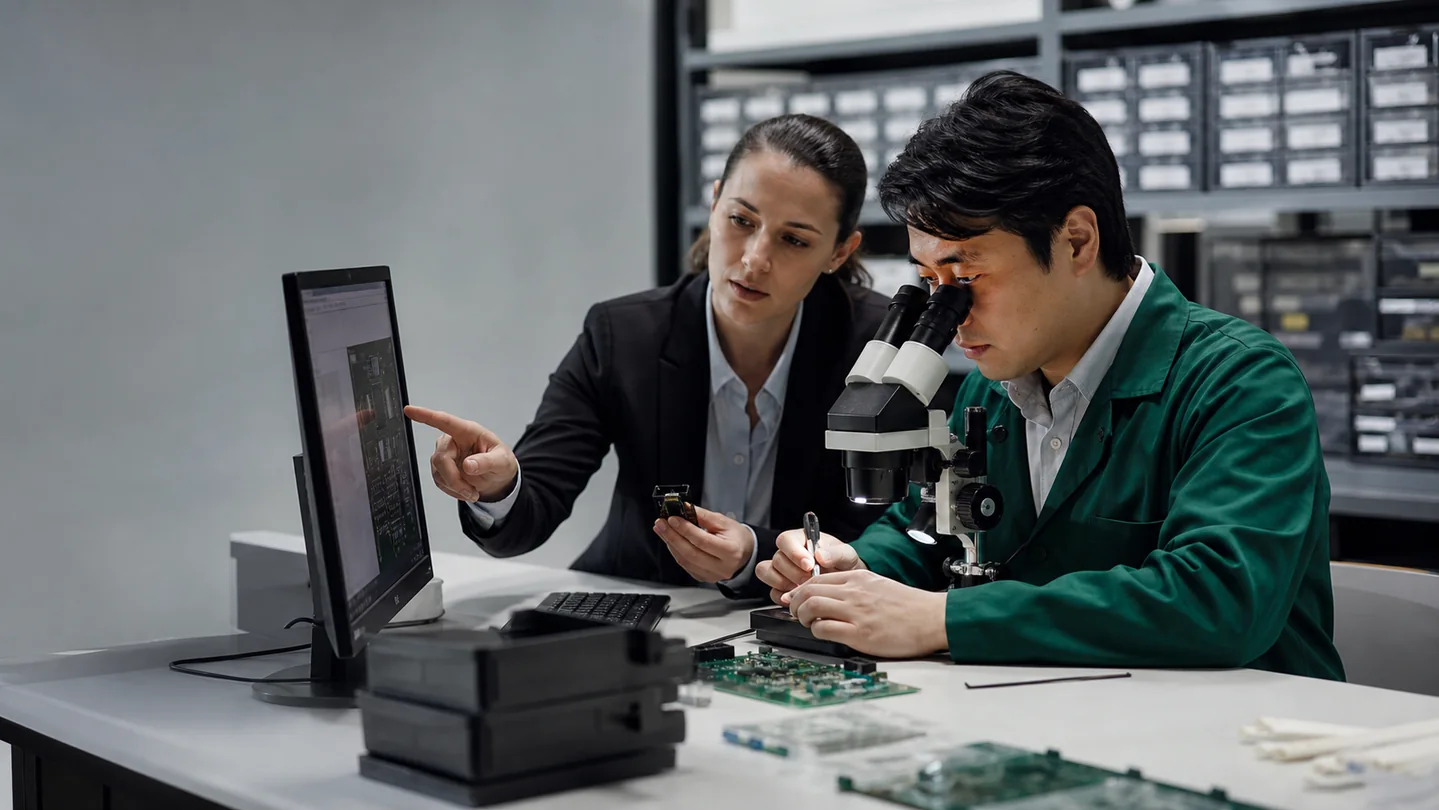
Composite example—not a customer testimonial.
VectorWave Electronics is fictional. The workflow and figures are illustrative and must not be read as realised SaleQMS results, certification or a guarantee.
Sales responded quickly, but substitutions, lifecycle status and compliance evidence were not reviewed consistently.
Design-in opportunities and quotations involving alternates, constrained supply or customer compliance requirements.
Why change?
The commercial problem was also a customer-quality risk.
A seemingly equivalent component could change form, fit, function, regulatory status or production continuity for the customer.
UNDERSTAND
Observed system
The team traced representative opportunities across customer contact, commercial decisions, operational interfaces and outcomes.
EVIDENCE
Evidence posture
Known facts, customer-confirmed requirements, internal inference, assumptions and missing information were kept visibly distinct.
The journey
Five steps from diagnosis to managed improvement.
The organisation tested a small, risk-relevant flow before extending the process.
01
DIAGNOSE
Trace actual customer journeys.
Sample recent wins, losses, changes and failures. Establish a baseline for customer experience, flow, rework, commercial outcome and risk.
02
DESIGN
Define the intended promise and ownership.
Agree the process purpose, scope, inputs, outputs, interfaces, decision authority and the conditions that require stronger review.
03
CONTROL
Introduce minimum useful controls.
- Verified manufacturer source and date for technical and lifecycle claims
- Explicit original-part, authorised-alternate and assumption status
- Engineering approval for material equivalence claims
- Traceable change notice and customer acceptance before substitution
04
PILOT
Use real work and remove friction.
A product line with frequent shortages was selected. Sales, product management and quality reviewed live quotations twice weekly until criteria and escalation paths became stable.
05
VERIFY & IMPROVE
Compare outcomes, causes and unintended effects.
Management reviewed whether the change improved customer and business outcomes. Corrective actions addressed systemic causes; completed activity alone was not accepted as proof of effectiveness.
Illustrative outcome
Measures that fit this sales system.
Replace every figure with a controlled organisational baseline and verified result.
These figures are narrative examples. They do not establish causation or predict an applying organisation’s results.
Quality-system connection
SaleQMS made commercial control part of normal management.
The case connects especially with ISO 9001 themes concerning requirements determination, externally provided processes and products, identification and traceability, change control and nonconformity. Exact applicability must be determined from the organisation’s context and authorised standard.